
Renovating an old wood floor: what gets saved, what gets replaced
Under the greyness, the stains and the scratches, there is often a magnificent wood floor waiting. But not always. Here is how I decide between renovating and replacing, and what it costs.
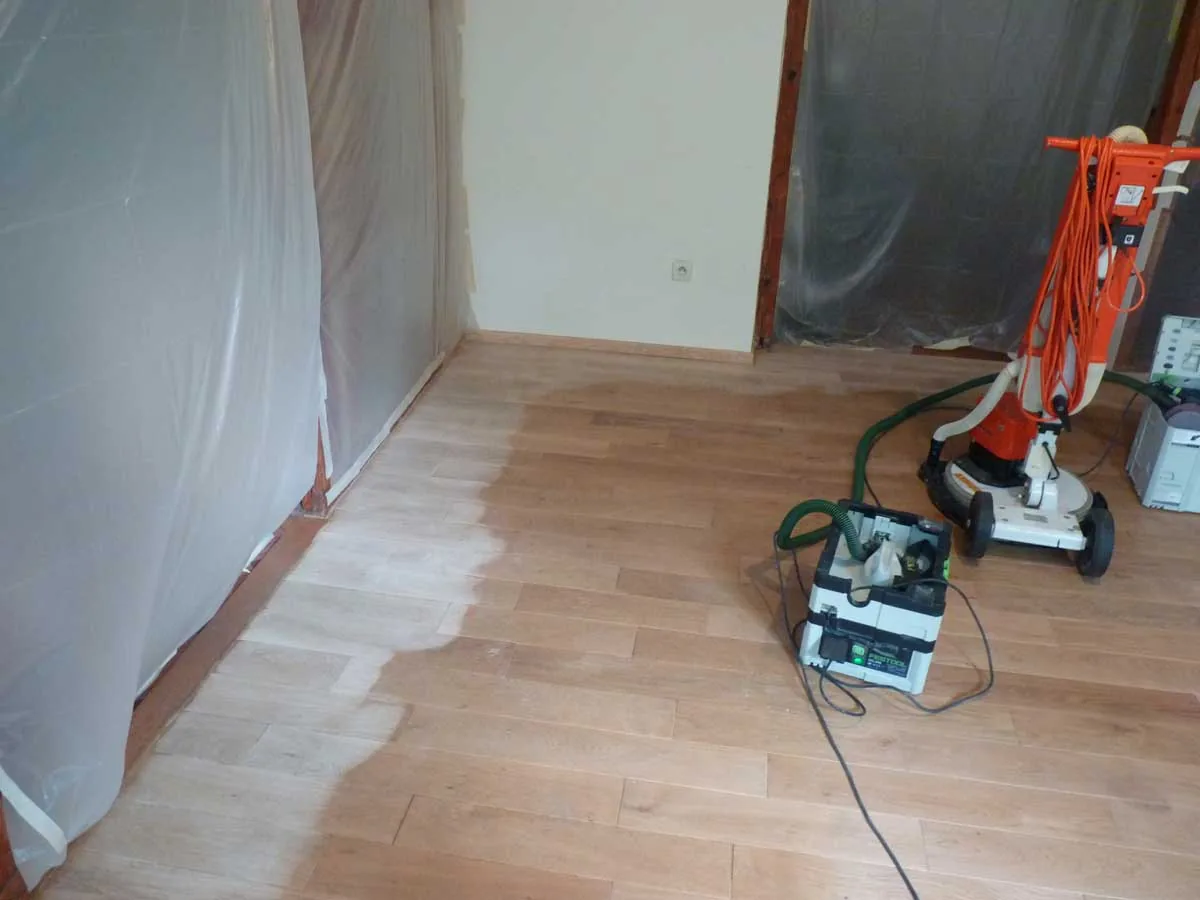
In the old houses of the valleys, the scenario is almost always the same. A wood floor laid 60, 80, sometimes 100 years ago, covered with carpet or lino in the 70s, rediscovered during a renovation. It is dull, stained, a few boards move. The question I then get asked: "is it dead, or can it be saved?" In the vast majority of cases, it can be saved. And the result surprises people every time.
What decides: the thickness of wood left
A wood floor can be renovated as long as there is enough material left to sand. Each sanding removes roughly 0.5 to 1 mm of wood. On an old solid floor of 20 mm or more, the reserve is huge: it can be sanded many times over its life. What needs checking is the remaining , especially if the floor has already been sanded several times. Below one millimetre above the grooves, we stop: one pass of the sander too many and the boards come loose.
My method, in four stages
Diagnosis
I probe the floor board by board: remaining thickness, dead boards, creaks, signs of insects, flatness of the subfloor.
Repairs
Replacing dead boards, refixing the ones that move, filling cracks with tinted wood filler.
Sanding
Two passes, from coarse to fine grit, plus the edge sander along the walls. The extraction captures almost all of the dust.
Staining and finish
On bare wood, you can stain, lighten or keep the natural colour, then protect it: floor sealer or oil.
The tricky part is the dead boards: rotten, split or too hollowed out. I replace them before sanding, ideally with old wood of the same species, salvaged on site or reclaimed. A brand-new board from the sawmill in a hundred-year-old floor will always show, even stained: old wood has a patina that new wood does not imitate. That is what I did on this renovation of an old wood floor: sanded back to bare wood then sealed, replacing nothing but what was necessary.
When replacing is honestly the better option
I would rather tell you before you spend a penny. Three cases where renovation is a bad idea. An insect attack that is still active: as long as the woodworm is working, sanding is pointless, you have to treat and often take the floor up. A sick structure underneath: if the have sagged or rotted, the wood floor is only the symptom: I had that case on a complete rebuild of a floor and its joists. And a floor already sanded too many times, with no wood left in reserve: there, we replace, or we lay a new floor on top if the height allows it.
Renovate or replace: the numbers
Indicative 2026 prices
| Full renovation (sanding, repairs, finish) | €30 to €80 per m² |
| New wood floor, supply and installation included | €50 to €120 per m² |
| Spot replacement of dead boards | on quote, depending on the species |
Ranges observed on the market and on my own jobs. The exact price depends on the state of the floor, the number of repairs and the finish. My quote (devis) is free and the price announced is firm.
My honest opinion: an old solid wood floor, I save it almost every time. Replacing it with new is often a mistake, and not only for the budget: the old oak or old pitch pine in our houses is generally of a quality you can no longer buy today at a reasonable price. Heartwood, wide boards, slow drying: that floor has already proved it can last a century. The latest example to date: the solid oak floor of a barn in Campan, around 90 m² sanded back to bare wood and sealed.
The gold-underlined words are explained on hover. All definitions are in the joinery glossary.
The details of my service are on the wood floor renovation page. And to choose the final protection, read my advice article sealing, oiling or waxing your wood floor.
Three questions that come up often
How much does it cost to renovate an old wood floor?
Expect €30 to €80 per m² for a full sanding with repairs and finish, depending on the state of the floor and the finish you choose. It is always cheaper than a new floor fitted, which starts at around €50 per m² and quickly climbs past €100 per m².
Does renovating a wood floor make a lot of dust?
Far less than it used to. Professional sanders are connected to an extraction system that captures almost all of the dust. A fine film remains to be cleaned at the end of the job, but it is nothing like the cloud clients fear.
Can you change the colour of a wood floor during renovation?
Yes. After sanding back to bare wood, the timber is raw: it can be stained before finishing, lightened or darkened. It is the right moment to do it, because a stain applied to bare wood penetrates evenly.