
Wood or composite decking: a joiner's opinion
I work with wood all day long, so you can guess my preference. But composite has real arguments, and lying to you would serve nobody. Here is the comparison I would have wanted to read in your place.
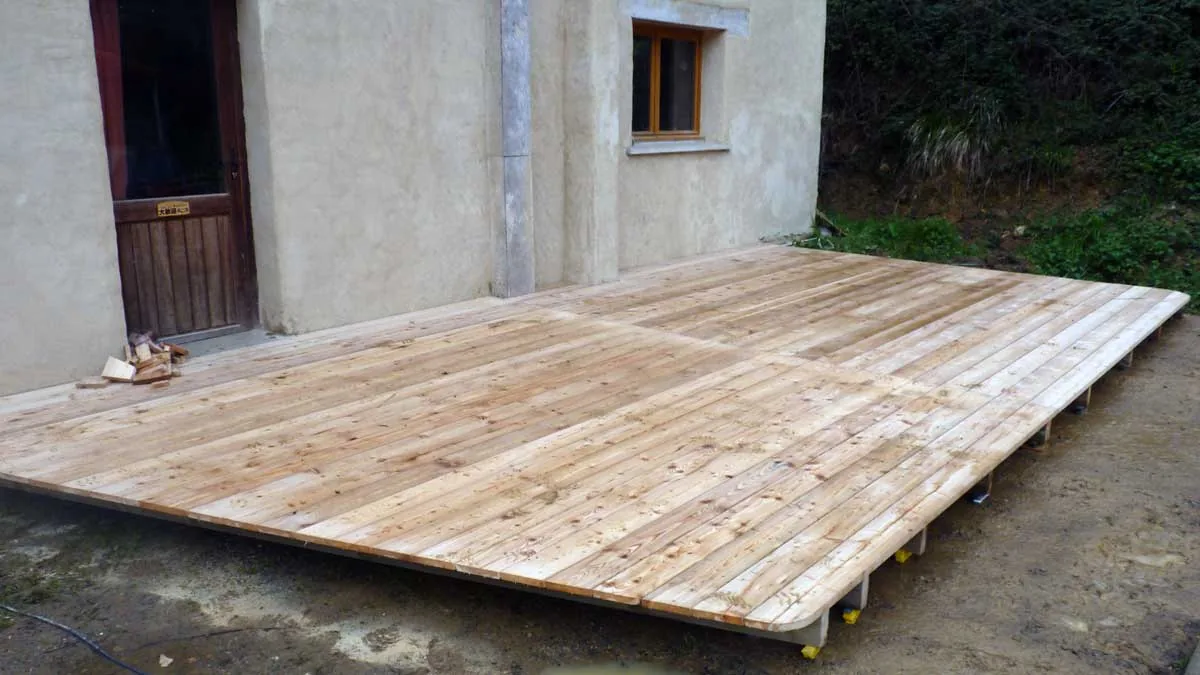
Composite has conquered the garden centres with a simple promise: the look of wood without the upkeep of wood. The promise is partly kept, and that is why it deserves to be taken seriously. But it also hides three or four realities the sales floor rarely mentions: the heat underfoot at the height of summer, the enormous gap between a budget composite and a good one, and a final price which, for the good products, exceeds that of a beautiful wooden deck.
The head-to-head, criterion by criterion
| Criterion | Wood | Composite |
|---|---|---|
| Upkeep | Annual clean; saturateur only if you want to keep the colour | Simple cleaning, no saturateur, no greying remover |
| In the sun | Heats up moderately, fine barefoot | Can climb to 60-70°C in dark shades |
| Looks and ageing | A living material, greys elegantly, can be repaired | Even and tidy; the entry level looks "plastic" and fades |
| Eco-balance | Very good with a local, lightly processed wood | 30 to 60% plastic; recycled exists but remains a minority |
| Boards alone | €25 to €90 per m² depending on species | €60 to €120 per m² for quality |
| Fitted, structure included | €120 to €250 per m² | €200 to €270 per m² |
What composite does really well
Let us be honest: on upkeep, composite wins. No greying to manage, no saturateur, no splinters: for a holiday let, a second home you see three weeks a year, or simply someone who never wants to think about it, that is a massive argument. Today's good composites, made by , have also fixed a good share of the material's early flaws: stains, rapid fading, a cheap look.
The trap is the entry level. at €30 or €40 per m² are fragile to knocks, sound hollow underfoot and age badly. If your budget only stretches to entry-level composite, a well-fitted class 4 pine will be more durable and better looking for the same money.
What they do not tell you in the shop
Heat first. Plastic stores heat: a dark composite can reach 60 to 70°C in full summer sun. Barefoot, that is a no. On a deck facing full south towards the Pyrenees, like this timber deck I built in the mountains, it is a serious criterion: choose a light shade or a range with reflective pigments if you go for composite. Then expansion: composite moves a lot with temperature, and a fitting that ignores the manufacturer's gaps ends up as rippling boards. Finally the eco-balance: you are comparing a local, lightly processed wood with a material that is half plastic, often extruded far away and not repairable. Recycled composite is making progress, but wood keeps a lead that is hard to dispute.
So, which one to choose?
My honest opinion: I prefer wood, and not out of loyalty to my trade. A well-designed wooden deck ages beautifully, can be repaired board by board, and tells a story no polymer tells. But if you tell me "I want strictly zero upkeep and I do not like the grey", then I will tell you to choose composite, on one non-negotiable condition: solid co-extruded boards, in a light shade, fitted by the book. Budget composite, for its part, is the worst of both worlds: the charm removed and the fragility added.
- You want the material, the touch, the repairability: wood.
- You want to forget your deck ten months a year: solid co-extruded composite.
- Full south, barefoot use, children: wood, or composite in a very light shade.
- Tight budget: a good class 4 softwood rather than an entry-level composite.
Co-extrusion, hollow board, use class: these terms are explained in my wood glossary.
If you go for wood, the choice of species for our climate is covered in which wood for a deck in the mountains, and the way I build is detailed on the timber decking page.
Three questions that come up often
Is a composite deck really maintenance-free?
Treatment-free, yes: no saturateur, no greying remover. Maintenance-free, no: it has to be cleaned like any outdoor floor, and the grooves in the boards hold dirt. Budget ranges can also fade and stain. Let us say: far less maintenance, not zero.
Does composite really heat up in the sun?
Yes, and markedly more than wood. A dark composite can reach 60 to 70°C at the height of summer: walking on it barefoot is impossible. Light shades and ranges with reflective pigments limit the effect, without cancelling it. Facing full south, it is a real deciding factor.
How long does a composite deck last?
Count on 15 to 25 years for a quality composite, often guaranteed 20 or 25 years by the manufacturer. Budget hollow boards age far less well: fading, brittle boards. And as with wood, longevity depends above all on the load-bearing structure.