Which wood for a deck in the mountains?
A deck at 800 metres of altitude does not live the same life as a deck in Bordeaux. Snow that stays for weeks, frost, harsh sun: here are the woods that hold up here, and the ones I advise against.
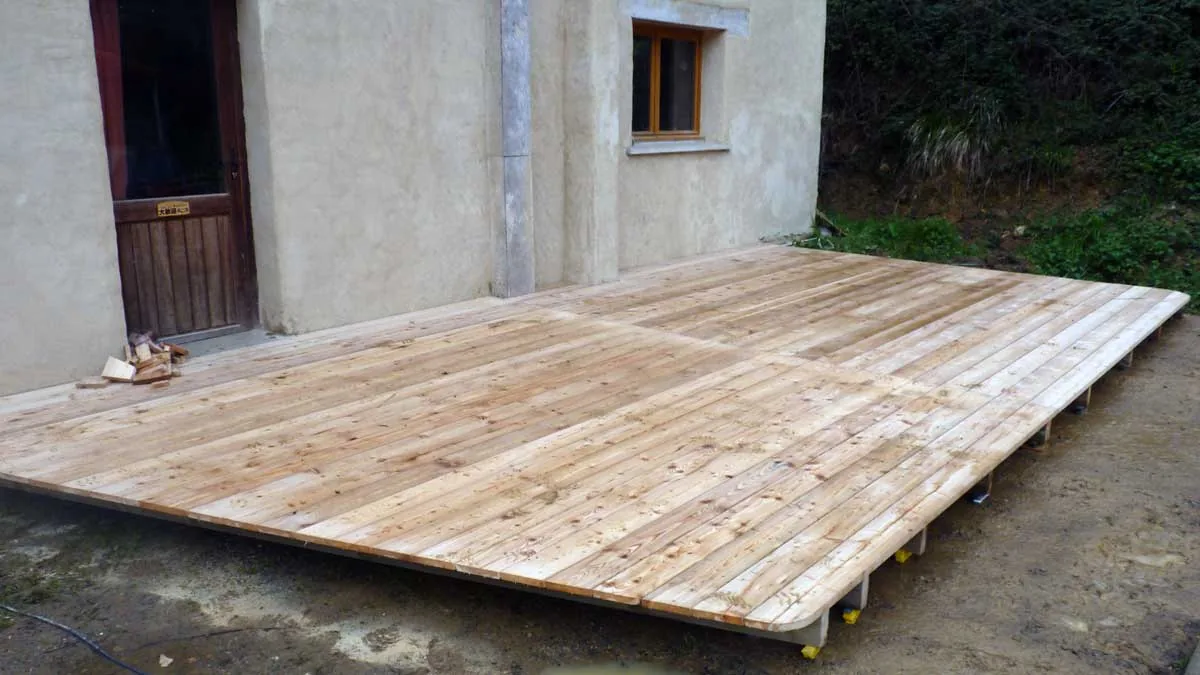
In the valleys of the Hautes-Pyrénées, a deck takes it all: snow that melts and refreezes, 25-degree swings within a single day, and UV radiation stronger than in the lowlands. Wood that lasts ten years by the sea can suffer here in five. The choice of species is therefore not a cosmetic detail, it is the lifespan of your deck.
What the mountains put wood through
Three main attacks. Frost first: water that gets into the wood and freezes bursts the fibres, especially at the ends of the boards. Snow next: its weight is not the problem, it is the prolonged damp as it melts slowly on poorly ventilated wood. UV last: at altitude, the radiation is markedly more intense and bleaches wood faster. The answer holds in two words: the right species and a ventilated structure. A deck with air circulating underneath dries fast, and wood that dries fast lasts a long time.
The species I fit here
| Species | Mountain performance | Board price | Worth knowing |
|---|---|---|---|
| Douglas fir | Good | €30 to €50 per m² | French-grown wood, naturally durable. The good value for money. |
| Larch | Very good | €40 to €70 per m² | The wood of high-altitude chalets. Dense, made for this climate. |
| Class 4 pine | Good | €25 to €45 per m² | Treated right through. The cheapest, with a plainer look. |
| Black locust | Excellent | €60 to €90 per m² | The most durable of European woods, with no treatment at all. |
Douglas fir is often my first choice for reasonable budgets: it is a locally grown wood, naturally resistant, which ages well if the structure is sound. Larch is the mountain wood par excellence: the hundred-year-old chalet claddings, that is larch. Pine treated to is the economical solution: less noble, but reliable if the treatment is serious. And black locust, sometimes called false acacia, is the only European wood that rivals the tropical species for durability: I keep it for projects aiming at the very long term.
Why I do not offer tropical wood by default
Ipe and cumaru are excellent woods, very durable. But I do not put them forward systematically, for two reasons. First, traceability is often doubtful: part of this timber comes from logging channels that are hard to verify. Second, we have species in Europe that do the job in our climate, at a comparable or lower price, with one shipment fewer. When a client insists on tropical wood, I demand serious certification. But honestly, a well-fitted larch or black locust deck has nothing to envy ipe in our valleys.
Maintenance, without kidding ourselves
All wood left outdoors goes grey. It is inevitable, and it is not a disease: it is the surface reacting to UV. Two options, and both are defensible. Let it grey: zero maintenance, the wood takes on an even silvery shade, and its durability is not affected. Or keep the colour: a applied every one to two years, at altitude rather every year on the south-facing side. What I advise against: film-forming varnishes and paints, which flake in the frost and force you to sand everything back. And in every case, a scrub with a stiff broom each spring to remove moss and debris.
The wood is not everything: the structure comes first
- in class 4 wood or in aluminium, never untreated wood in contact with the ground.
- Honest ventilation under the boards: air must circulate to dry the wood after the snow melts.
- A slight fall to drain the water away, and gaps between boards calculated for the shrinkage and swelling of the wood.
- Stainless steel fixings: in the mountains, zinc-plated steel always ends up bleeding rust streaks.
A deck that rots in five years is almost never the wood's fault. It is a structure that traps damp. That is where the craftsman's work makes the difference, more than the choice of species.
To see examples and the way I work, have a look at my timber decking page or the timber deck facing the Pyrenees project.
Three questions that come up often
My decking is turning grey, is it serious?
No, it is normal. Greying is a surface reaction to UV, not a degradation of the wood. If you like the grey shade, there is nothing to do. If you prefer the original colour, a saturateur applied every one to two years keeps it.
Do you need to clear snow off a timber deck in winter?
It is not compulsory if the structure is well ventilated: wood can take the snow. Just avoid the metal shovel, which scratches the boards, and go for a plastic shovel or a broom. The real enemy is standing water, not snow.
How long does a timber deck last at altitude?
With the right species, a ventilated structure and stainless steel fixings, count on 20 to 30 years, and more for black locust. What ruins a deck in the mountains is almost never the wood itself: it is a badly designed structure that holds the damp.