Looking after a wooden deck: fact and fiction
The maintenance aisle of the DIY shops would have you believe a wooden deck is a patient that needs treating. It is not true. Here is what is really useful, what is marketing, and what does damage.
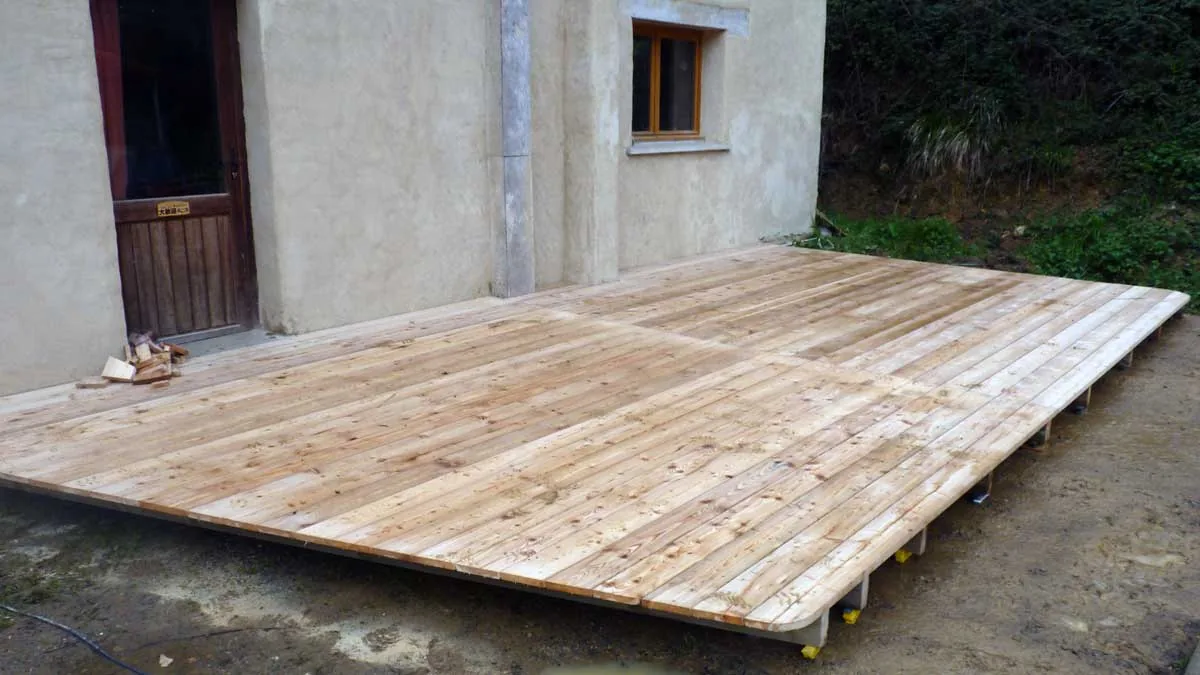
I build decks in the valleys of the Hautes-Pyrénées, like this deck facing the Pyrenees, and the maintenance question comes up at every handover. My answer often surprises: a well-designed deck asks for very little. Most of what you are sold in colourful tins serves the colour, not the lifespan. Let us take it point by point.
Greying: a matter of taste, not of health
All wood left outdoors turns grey. It is not a disease, not rot, not a sign of neglect: it is the surface of the wood reacting to UV, over a few tenths of a millimetre. The strength of the deck is not affected in the slightest. The silvery-grey barn claddings of our valleys have been there for a hundred years to prove it. The only real question: do you like the grey? If yes, there is nothing to do. If not, there is the duo of then saturateur.
Saturateur: useful or marketing?
Both, and it needs saying clearly. The does very well what it promises: it keeps the warm tone of the wood, provided you reapply it every one to two years, rather every year facing full south and at altitude. What it does not do, on the other hand: extend the life of your deck. Durability comes from the species chosen and the ventilated structure, not from the tin.
My honest opinion: saturateur is a cosmetic comfort, not a technical necessity. A deck I have designed properly does not need it to last thirty years. I say this knowing I could charge you for an application every year: if someone presents saturateur as vital for the wood, they are selling you something.
Cleaning: why I advise against the pressure washer at full power
It is the most common mistake, and the most expensive one. A pressure washer used up close, at full power, tears up the surface fibres of the wood: it hollows out the soft zones, lifts the grain, brings out splinters. The deck looks clean at the time, then turns rough, catches dirt faster and ages prematurely. Softwoods like pine or Douglas fir are the most vulnerable. What works, without risk: a stiff broom, water, savon noir (French black soap), and a rinse with the garden hose. Once a year, in spring, is enough. If you are attached to the washer: low pressure, wide nozzle, and a good distance from the boards.
Moss and black stains
Moss grows where water sits and light is lacking: shaded corners, the junction with a wall. It comes off with a stiff broom and savon noir or diluted sodium percarbonate. I avoid bleach: it whitens the wood by attacking its fibres and burns the plants below. Black stains, for their part, most often come from a reaction between the wood's tannin and metal: a forgotten watering can, a garden furniture leg, a rusting fixing. That is also why I only fit stainless steel fixings.
The realistic calendar
| When | Essential | If you want to keep the colour |
|---|---|---|
| Spring | Clean with a stiff broom and soapy water, de-moss the corners | Greying remover if needed, then saturateur on clean, dry wood |
| Summer | Nothing | Nothing |
| Autumn | Remove dead leaves and debris from between the boards | - |
| Winter | Nothing: snow does no harm. A plastic shovel if you clear it | - |
That is all. Half a day a year for the essentials, a full day if you apply saturateur. If your deck needs more than that to stay healthy, the problem is not the maintenance: it is the design, and it needs correcting.
Greying remover (dégriseur), saturateur, use class: these terms are explained in my wood glossary.
Still at the project stage? The choice of species is covered in my advice piece which wood for a deck in the mountains, and the way I build is on the timber decking page.
Three questions that come up often
Can you use a pressure washer on a wooden deck?
Not at full power and not up close: the jet tears up the wood fibres, brings out splinters and ages the deck prematurely, especially on softwoods. If you insist, low pressure, wide nozzle, at a good distance. A stiff broom and soapy water do the same job without the risk.
My deck is turning grey, should I worry?
No. Greying is a reaction of the wood surface to UV, purely cosmetic: the strength of the deck is not affected. If you like the grey, there is nothing to do. Otherwise, a greying remover then a saturateur bring back the original colour.
Is saturateur really essential?
No. Saturateur maintains the colour of the wood, not its strength. A well-designed deck, with the right species and a ventilated structure, lasts for decades without saturateur: it will simply be grey. It is a cosmetic choice, not a technical obligation.