
Wood-based panels: a cabinetmaker's complete guide
MDF, melamine, laminate, OSB, plywood: behind these names hide very different materials, all made from transformed wood. Here is what each one does best, how it is made, and what it costs in 2026.
A "wood-based panel" is a board made by deconstructing wood and putting it back together: as particles for chipboard, as fibres for MDF, as large strands for OSB, as whole sheets for plywood, or as glued-up staves for solid wood panels. On top of that base come the facings, melamine, laminate, fine wood veneer, and one intruder that has nothing woody left about it, the solid surface resin of the Corian type. In my workshop in Gerde, near Bagnères-de-Bigorre in the Hautes-Pyrénées, almost all of these materials pass through my hands. This guide walks you through them one by one, without needless jargon, with their real uses and their real pitfalls. I speak English, so feel free to call or write in English.
The dashboard: every panel in one line
| Panel | In a nutshell | Typical uses | Price per m² |
|---|---|---|---|
| Chipboard | Pressed wood particles | Hidden structure, sub-layers, budget carcasses | €8 to €15 (€30 moisture-resistant) |
| MDF | Pressed fine fibres, perfect surface | Lacquered fronts, mouldings, painted panelling | €15 to €25 |
| Valchromat | Through-coloured, reinforced MDF | Raw design furniture, tops, colourful interiors | €45 to €60 |
| Melamine | Chipboard faced with a pressed decor | Kitchen carcasses, wardrobe interiors | €10 to €25 |
| HPL laminate | High-pressure sheet glued onto a board | Worktops, hard-working fronts | €25 to €130 (finished worktop) |
| Compact | Solid laminate, 8 to 13 mm through and through | Bathrooms, cubicles, tops, splashbacks | €90 to €120 |
| Solid surface (Corian...) | Acrylic resin and minerals, seamless | One-piece tops and basins | €450 to €750 (fabricated) |
| OSB | Large strands, oriented and crossed | Structure, bracing, assumed raw look | €15 to €25 |
| Plywood | Crossed and glued sheets of wood | Drawers, backs, exposed-edge furniture, bending | €40 to €90 |
| Three-ply / laminated panel | Real solid wood re-composed into a panel | Worktops, mountain interiors, solid carcasses | €40 to €200 depending on species |
| Veneered panel | Fine wood sheet on a stable board | Fronts and sides with a noble wood look | Between melamine and solid wood |
The gold-underlined words are explained on hover. All definitions are in the joinery glossary.
Chipboard: the invisible soldier
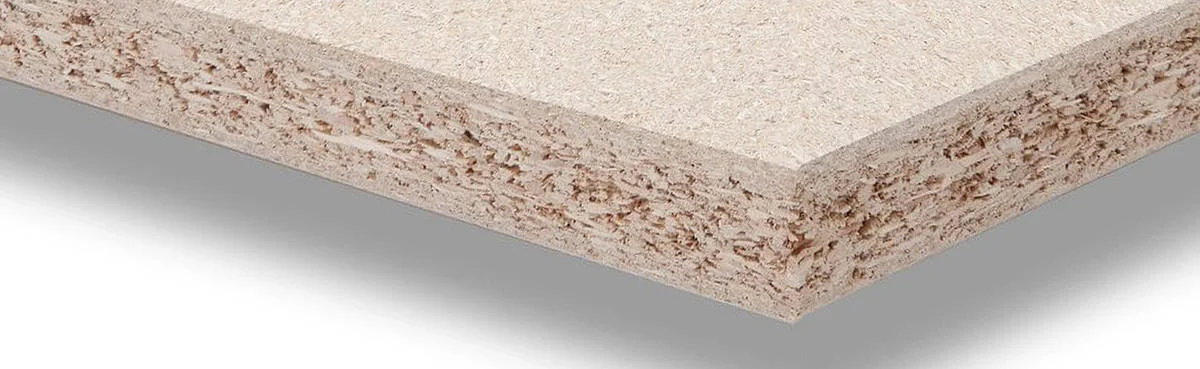
Particle board, or chipboard, is made from chips and sawdust, often sawmill offcuts: the particles are dried, glued and hot-pressed in three layers, fine ones at the surface for flatness, coarse ones at the core for stiffness. It is the cheapest panel on the market, around €8 to €15 per m² in 19 mm, and it is what hides inside the vast majority of flat-pack furniture, under its melamine coat. Its limits: it fears water more than any other panel, its edges crumble, and screws only hold properly in the face, not in the edge. The European standard EN 312 grades it from P1 to P7 by use; in practice, remember P2 for dry interior fit-out and P3, the famous green moisture-resistant CTBH board at around €30 per m², for damp rooms.
MDF: the workshop's blank canvas
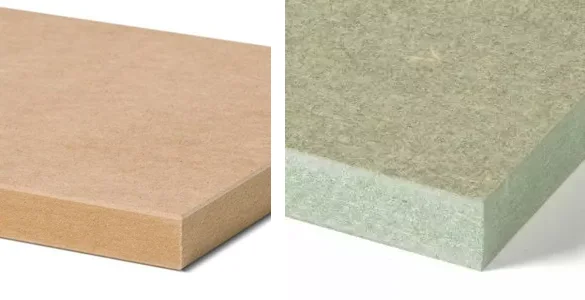
MDF pushes the deconstruction one step further: the wood is steam-defibrated between two discs, and it is these fine fibres, glued then hot-pressed at around 200 °C, that give a perfectly homogeneous panel, with no grain and no knots. The result: an ideal surface for lacquering and a material that routs beautifully, mouldings, handle grooves, patterns. It is the panel of lacquered fronts and painted panelling, at around €15 to €25 per m². Its colour vocabulary is simple: brown is standard, green is moisture-resistant for damp rooms, count roughly double the standard price, and pink is fire-rated, required in public buildings. It also comes in a lightweight version for large wall-hung carcasses and in a very dense version, HDF, found under laminate flooring.
Valchromat: the MDF with colour in its veins
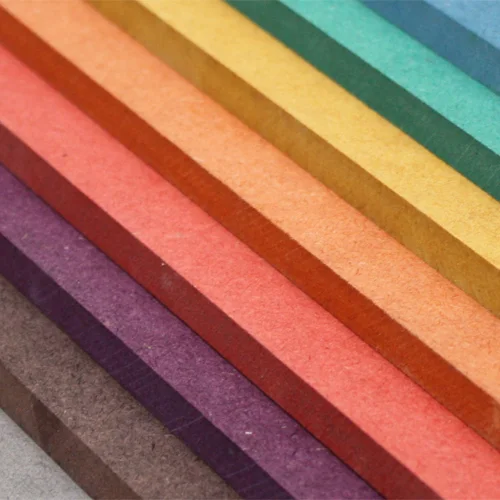
Valchromat is an MDF whose fibres are dyed in the mass before pressing: cut it, rout it, sand it, the colour is everywhere, edges included. Valchromat is actually a brand, registered by the Portuguese maker Investwood which produces it there; other manufacturers offer equivalents, such as Fibracolour from Spain. The panel is also about 30% stronger than standard MDF thanks to its specific resins, and it is moisture-resistant by nature. A dozen colours exist, from deep black to blue via chocolate and khaki. It is the darling material of contemporary furniture left raw or simply oiled: no edging to apply, no lacquer, the machining IS the finish. A scratch is rescued with localised sanding. Count around €50 per m² in 19 mm at the merchants that stock it.
Melamine, laminate, compact: the same family, three levels of armour
Melamine is chipboard onto which a sheet of decorative paper impregnated with melamine resin is hot-pressed, directly. A single sheet: that is what makes it economical, €10 to €25 per m², and it is also its limit against knocks. It reigns over kitchen carcasses and walk-in wardrobe interiors, and it does that job well: stable, clean, easy to look after. Its Achilles heel is elsewhere: the edges, which must be properly banded, and I refer you to my solid wood, MDF or plywood comparison to know when it belongs and when it does not.
HPL laminate, for high pressure, is a material in its own right: around sixty per cent kraft paper, impregnated with resins, pressed in the factory into a dense sheet of one or two millimetres, which is then glued onto a core board. This multi-layer armour shrugs off knocks, scratches and the heat of a saucepan set down for a moment. It is the king of the budget worktop, €25 to €130 per m² finished: my worktop comparison gives it its due against quartz and ceramic. Some versions can be around rounded edges.
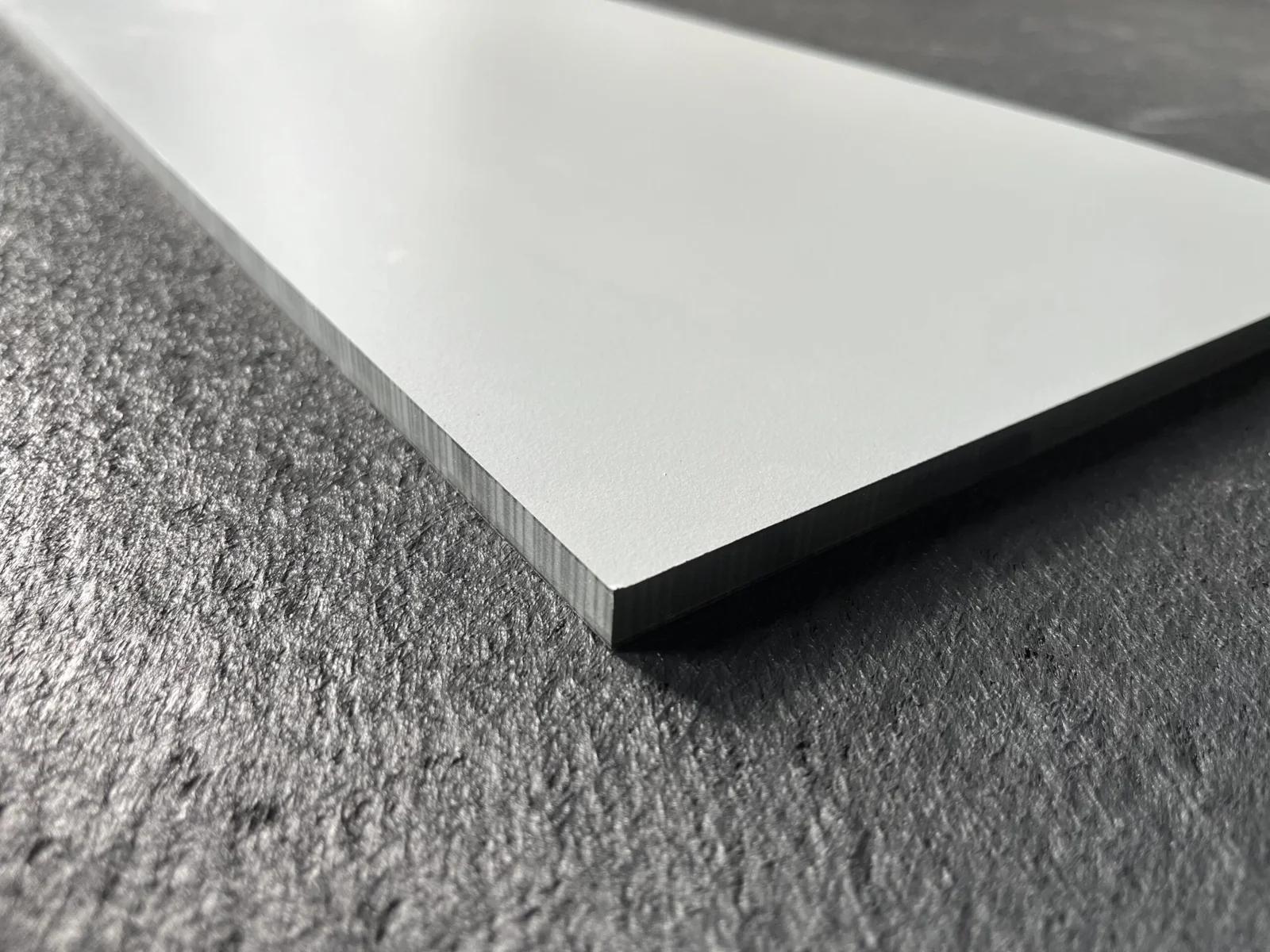
Compact, finally, is laminate through the whole thickness: 8 to 13 mm of pressed layers, no core board, decor on both faces. Impervious to water, knocks and household products, it is what equips swimming pool cubicles and public washrooms, and it works wonders as a splashback, a basin top or a bathroom cabinet front. Around €100 per m² in 10 mm. Its distinctive black edge, left visible, has become a design signature.
Solid surface, Corian and friends: the material that welds
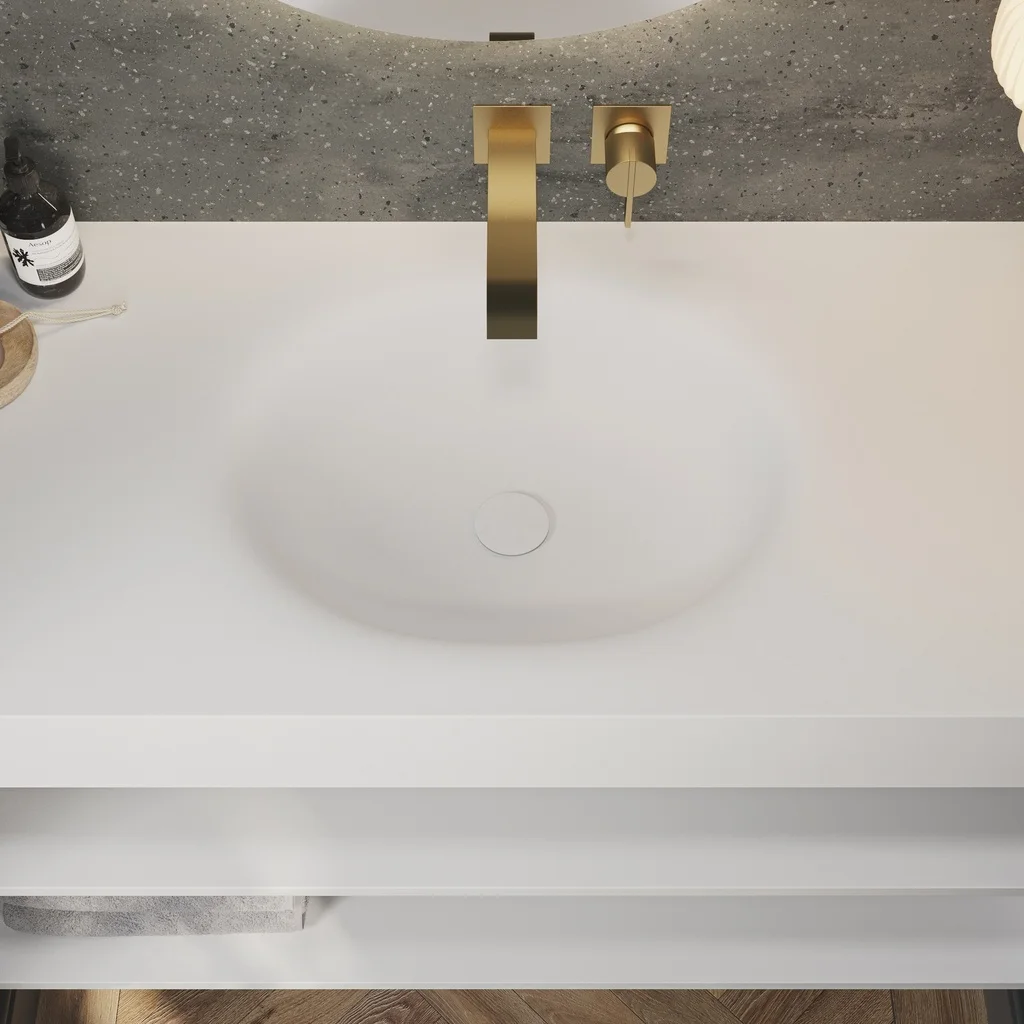
Here we leave wood behind: solid surface, of which DuPont's Corian is the historic brand, is made of roughly two thirds acrylic resin and one third minerals. Its appeal holds in three words: homogeneous, weldable, repairable. The material is identical from surface to core, two sheets weld chemically into an invisible joint, a basin joins the top without the slightest seam, and the material thermoforms at around 160 °C to hug curves. A scratch or a light burn sands out. The limits are real: direct heat above 100 °C marks it irreversibly, trivet compulsory, and the price is that of the specialist work it demands, count €450 to €750 per m² fabricated. It is a product for specialist fabrication workshops more than general joinery, and a good joiner will tell you so rather than improvise.
OSB: the strongman that no longer hides
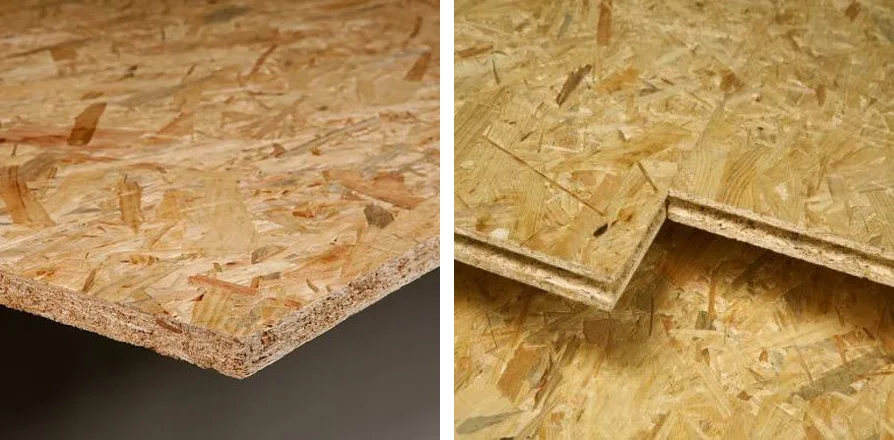
OSB, for Oriented Strand Board, is made of large strands of wood, oriented then crossed in layers and pressed. That orientation gives it genuine mechanical strength: it is a structural panel, the one used for bracing timber-frame houses, technical floors and workshops. Grades run from 1 to 4, OSB3 being the standard for structural use in humid conditions, at around €15 to €25 per m² depending on thickness. In recent years its strand pattern has been embraced in decoration, on walls as in raw varnished furniture. I like that kind of honesty, provided you choose a quality sanded panel and take care of the edges, which remain its weak point.
Plywood: crossed sheets, quiet strength
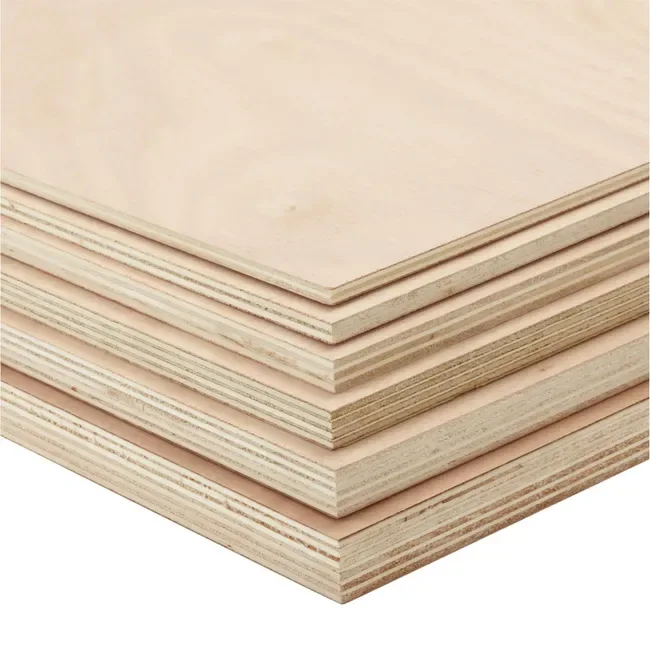
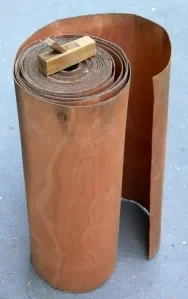
Plywood is the oldest and noblest of the panels: the log is peeled into thin sheets of wood, which are then stacked with crossed grain, in odd numbers, and glued under press. Each ply cancels its neighbour's movements: you keep the character of wood, without its whims. Birch offers a magnificent striped edge that is left visible on contemporary furniture, poplar plays the lightness card, and okoumé in CTBX grade, the French marine grade, takes prolonged damp environments in its stride. It bends, which no other panel does as well, and it holds screws better than any particle or fibre board. Count €40 to €90 per m² for good quality. Beware, though, of budget exotic imports: hollow plies and mediocre glues end up as a warped panel.
Three-ply and laminated panels: solid wood, tamed
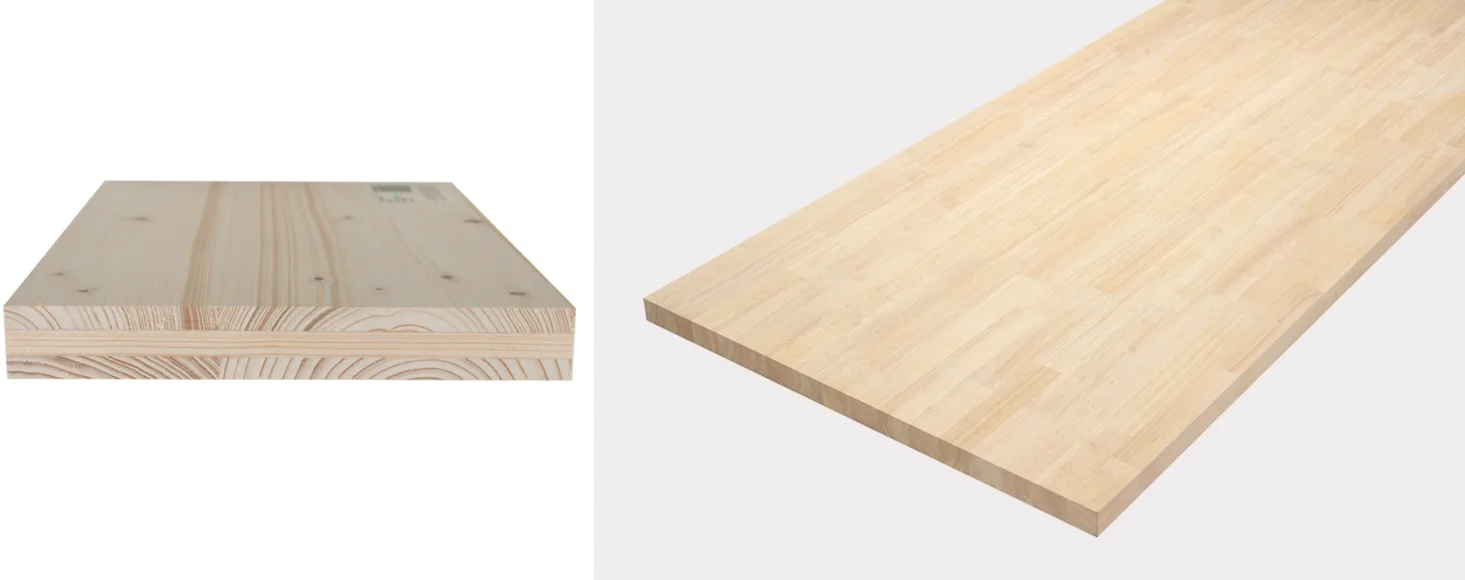
These two are real solid wood, simply re-composed to be stable. The three-ply panel stacks three layers of solid staves with crossed grain, most often in spruce, but it also exists in Douglas fir or oak: it is the panel of mountain interiors, warm panelling and raw furniture, at around €40 to €45 per m² in spruce. It is in three-ply spruce that I built this bookcase fitted right up to the sloping ceiling in Gerde. The , for its part, glues solid staves side by side, finger-jointed or continuous: it is the material of wooden worktops, from beech at around €75 per m² to oak between €100 and €200. It is exactly what I restored and fitted on the oak worktops of this barn in Campan: solid wood that stays flat, year after year. To understand why single-piece wood moves so much, read why wood moves.
Veneer: fine wood laid over stability
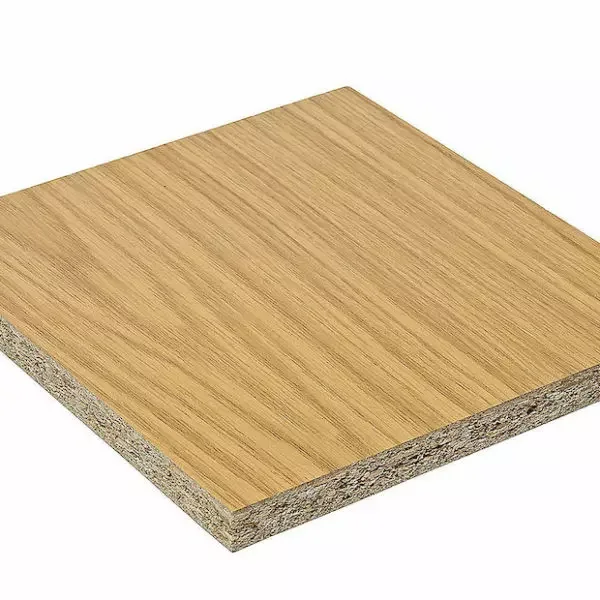
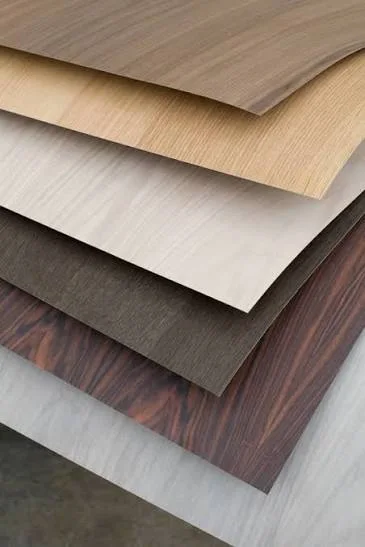
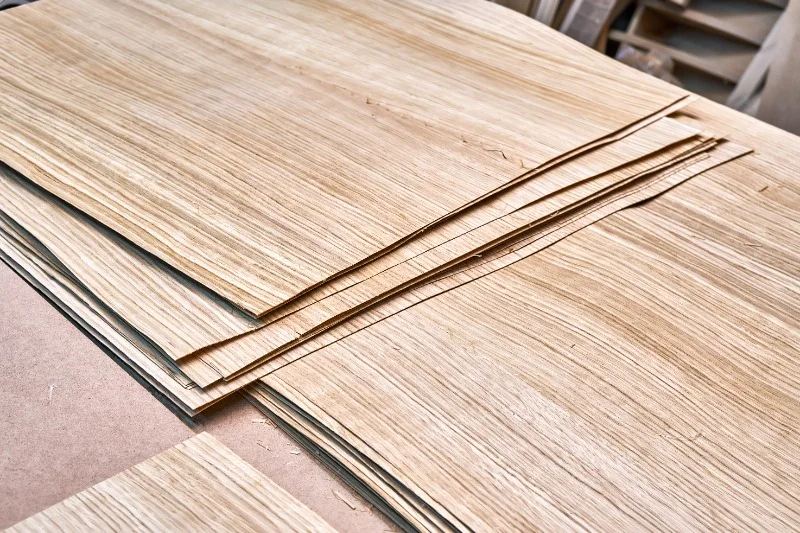
Veneer is the trade's answer to a question as old as furniture: how to offer oak, walnut or ash over large surfaces without the distortions of solid wood, or its price. The sheet of wood is sliced from the log at around six tenths of a millimetre, then glued onto a stable panel, MDF, chipboard or plywood. The panel is then said to be veneered. The grain is real, the touch is real, the stability is that of the panel, and one cubic metre of fine log dresses many times more furniture than it would as solid boards. On visible edges, a of solid wood protects the edge and allows round-overs. Almost every panel in this guide can receive a fine wood veneer: it is what dresses most of the "wood" fronts of high-end furniture, and to choose the species itself, my guide to which wood for a piece of furniture takes over.
Moisture-resistant, fire-rated: translating the labels
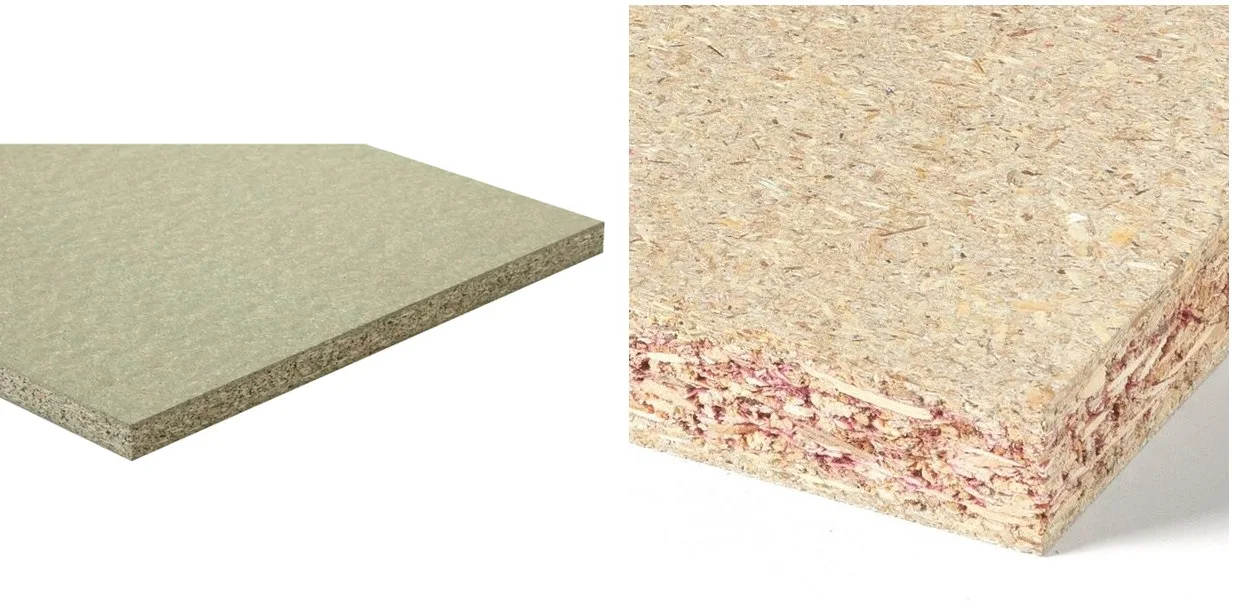
Moisture-resistant does not mean waterproof. A moisture-resistant panel, tinted green, gets glues that strongly delay swelling in the presence of humidity: standard EN 312 grades particle boards, P3 and P5 for humid conditions, and the equivalent exists for MDF. It is made for the damp air of a bathroom or a kitchen, not for soaking: an unrepaired leak will swell it too, just more slowly. Fire-rated does not mean fireproof: a fire-rated panel, tinted pink or red, burns later and more slowly. Performance is read in Euroclasses, from A1 to F: a fire-rated MDF or laminate typically reaches B-s2,d0, meaning a very limited contribution to fire, moderate smoke and no flaming droplets. These panels are required in French public buildings; in a private home, they are only called for on specific projects. Finally, every panel legally sold in France meets the E1 formaldehyde emission class, and once lacquered or veneered, they emit even less.
What I do with all this at the workshop, concretely
My honest opinion: there is no bad panel, only panels in the wrong place. A kitchen carcass in 19 mm MDF or melamine with good edges and serious hardware will last decades; the same carcass in 15 mm chipboard with budget edging will die young, and that is not the material's fault. In my workshop, the logic is simple: the structure goes to the stable panel, MDF, thick melamine or solid wood panel depending on budget, the fronts go to what is seen and touched, lacquer on MDF, fine wood veneer, solid wood or raw Valchromat depending on the project, and the worktops go to laminated solid wood or laminate depending on use and budget. The quote I hand you details panel by panel what I put where: carcasses, fronts, materials, hardware, line by line. It is your right to know exactly what is under the lacquer, and the quote (the French devis) is free. I speak English, so feel free to call or write in English.
Three questions that come up often
What is the difference between melamine and laminate?
The structure of the facing. On a melamine-faced panel, a single sheet of resin-impregnated decorative paper is pressed directly onto the board. HPL laminate is a stack of kraft paper sheets and resins pressed separately, under high pressure, then glued onto the board: the facing is thicker, so far more resistant to knocks and scratches. That is why a worktop is laminate and a cabinet carcass is melamine.
Does moisture-resistant mean waterproof?
No, and it is the most common misunderstanding. A moisture-resistant panel, recognisable by its green tint, swells much more slowly than a standard panel when humidity is about. It is made for the damp air of a bathroom, not for soaking in water. An untreated leak will eventually get the better of any moisture-resistant panel: only the sealing of the room and the worktops really protects the furniture.
Can you get the look of solid wood with a panel?
Yes, that is exactly what veneer is for: a real sheet of oak, walnut or ash, less than a millimetre thick, glued onto a stable panel such as MDF or chipboard. You get the grain and feel of genuine wood with the stability of the panel, at an in-between price. On visible edges, a solid wood lipping, the alaise in French, completes the illusion and protects the edge.